Monday, November 10, 2008

wonder in memphis

On the night Barack Obama was elected president and in the days that followed, I was down in Memphis, arguably the most racially divided city in the U.S. To this day a statue of Nathan Bedford Forrest, a lieutenant general in the Confederate Army during the Civil War and the first Grand Wizard of the Ku Klux Klan still stands prominently in Memphis' central park. And the city's population remains mostly divided by the freeway "loop" that neatly separates whites from blacks.

As we (most of CRM's senior leadership) met with African American pastors and community leaders during the week, their pride in what had just happened was palpable. But it wasn't loud. It wasn't even triumphant. It was closer to shock. It almost felt like the men and women we met with were lost in the wonder of the moment and were still wondering if it had really happened, or if it was all just a dream.

Just 40 years earlier Dr. Martin Luther King was assassinated on a balcony just outside his room at the Lorraine Motel in downtown Memphis. The motel has been converted into the National Civil Rights Museum and it was something we wanted to experience. It was a bit surreal for us to be there just hours after the election, knowing that the President-Elect of our country could not have even sat with us or eaten with us just 40 years ago, let alone lead us. I would have expected the place to be party central on November 5th, but It was nearly empty. There were no celebrations at the motel or in the streets...at least not the streets we walked. King had talked about a day when an African American would become president of United States, but his forecast of a black president within 25 years had long since elapsed and for many his dreams had long since been tempered.

One African American leader told us, "You know, we've always told our children they could become anything they wanted to become in this country, but not the president. Today, for the first time, I can look my kids in the eye and honestly tell them they can become anything they want to become, and now I don't have to add 'but'."

To see the wonder in their faces and to hear the hope in their voices was enough for me to celebrate the choice our country made.

Friday, August 01, 2008

soul graffiti

I'd heard great things about Mark Scandrette's book, Soul Graffiti, and I've been wanting to read it ever since we shared some tasty Thai food together last year. But I'd been feeling pretty OD-ed on books about new forms of church, so it took awhile to get to it. But I'm glad I finally got around to reading it because it's not so much about what the church should be as it is about the kind of people we can be as we intentionally put ourselves in the pathway of needs. Mark is one of those gifted people who naturally connects with people who don't share his beliefs and has a beautiful way of making the divine both understandable and compelling. I don't do that so naturally, but I'd like to, and a book like this sure helps. Here are just a handful of thoughts I highlighted from his book that might encourage you to go grab a copy of the book for yourself and give it a good read:

3: "No matter our aesthetics, there is something in the motivation of the graffiti artist that we can identify with, a guttural yelp to be heard and understood, to talk back to the universe or to God when we feel helpless, abandoned, or overwhelmed. It may be that impulse we feel to find our place of significance in the wider world, or to initiate conversation with our Make."

80: Some would say that atheists have the most courage--because of the terrorizing implication that life is without meaning or purpose"

128: "Dwelling is about connecting your words, symbols, and expressions with the ongoing conversation of meaning in your culture."

144: "We live in a fragmented world where we all yearn for wholeness."

161: "The message of Jesus is that shalom is now possible...there is a new way to be human."

172: "Who can we love a God we don't see? By loving the people we can see."

200: "Our culture allows us to claim belief without validating faith by actions."

214: "Jesus unapologetically invited people to abandon their pursuit of pleasure or wealth in order to seek the reign of love."

219: "Entering the kingdom of God is a lot like doing the Hokey Pokey on roller skates."

230: "The place to start is with your next step."

Tuesday, June 17, 2008

reggie mcneal keeps it simply profound

Set aside 45 minutes sometime soon to hear a good 'ol boy call out the church to be what it's supposed to be.

http://video.google.com/videoplay?docid=-7739099929211880163&hl=en

Thursday, May 22, 2008

a break from drinking

A friend and colleague of mine recently posted something on his blog I thought was worth passing on. Here it is with my comments immediately following:
......

I stopped drinking at the end of April. At least for a while.

Why?

1. I really felt God was asking me to. Beyond any particular reason or explanation, I’ve had this growing sense that I must.
2. I have sensed that God is wanting to do something significant - in me? through me? Perhaps this is a bit of physical fast to reinforce the spiritual - a time of preparation.
3. I don’t want to miss ANYTHING - good conversation with a friend, opportunity to hear or see God, etc.- because I’ve been drinking. Although I never drink all that much anyway, I’d hate for that to be the reason I miss something.
4. Sometimes I look at people who have been drinking (either too much or too often), and wonder, “Am I like that?” Again, don’t think so, but I’d hate for someone to get a wrong impression or be turned off by that
5. A fair amount of our community drinks, and I guess I want to lead the way in moderation in this area.

The thing is, drinking isn’t wrong. But it sure is easily abused. And because this isn’t a black and white issue, it gets a little complicated when it comes to “how much.”

- When exactly has someone had too much too drink?
- When is someone drinking too often?

I often don’t know when it comes to someone else. I’m concerned that too many of us can’t answer these questions for ourselves. Perhaps a bit of what God wants to teach me is self-control, discernment, and moderation. I don’t anticipate this is a permanent stop, and don’t actually have a plan to end. I guess I’m counting on God indicating it’s ok to drink again as strongly as He told me to stop.
................

Good for you. I suspect God is nudging us all the time to change directions, to take a new path, to try doing more of one thing and less of another, or even to just try letting go of something to see what happens in us and around us. But most of the time I think we kinda just give God a non-verbal, barely conscious, “Huh,” and then continue on unmoved and unchanged. At least I do. So good for you for listening and acting.

I agree with you that there’s nothing inherently wrong with drinking, but I’ve thought for quite awhile, (and folks in our communities are probably tired of hearing me say it), that our casual and often cavalier attitude about the use of alcohol seems to reveal a naivetĂ© about the havoc it’s wreaking all around us and sometimes an insensitivity to those in our communities who are susceptible to hurting themselves with it. I hope we’ll be different. I hope we’ll be increasingly wise, sensitive, loving, and as you’re demonstrating, attentive to the nudgings of God.

Monday, May 19, 2008

trickle down mythology

I’m a registered Republican, and I’ve actually voted for every Republican candidate from Ronald Reagan in 1980 right through Mike Huckabee’s improbable run in this year’s presidential primaries. My folks are die-hard Republicans, so I guess I kind of just fell into the party. But I’m also naturally optimistic and I tend to think that most people will do the right thing if given the chance, so the Republican idea of a “small government” that frees up resources for people to do the right thing, (vs. a big government that does it for them), made sense to me. I bought into Reagan’s “trickle down” economic philosophy way back in 1980, but unfortunately the altruism of that policy hasn’t really played out in the real world.

Forbes magazine, the self-proclaimed "Capitalist’s Tool,” recently reported that the average CEO in 1980 was paid 40 times more than their average employee, but that by 2008 the average CEO was now making 443 times more than their average employee, a staggering discrepancy. Revenue is not trickling down, it’s being consumed at the top, and at alarmingly skyrocketing rates.

There are obviously exceptions. I know a few honorable CEOs who have voluntarily chosen to cap their salaries, to live more simply, and to pay their employees real living wages that are just and equitable with their own compensation. But sadly, when given the economic opportunity to make more money and distribute it more equitably and justly, most CEOs just aren’t choosing to do the right thing. And now I’m asking myself what’s the right thing for me to do with a historic election just around the corner.

Saturday, May 03, 2008

formed or informed

For the first 2/3rds of my life I mostly read the scriptures informationally. The last third I've mostly read the scriptures formationally. Both are helpful, but they are different. The difference has to do with how we read the Bible and why we read it. Either we read the Bible informationally to learn, or we read it formationally to be changed. M. Robert Mulholland characterizes the different approaches like this:

In informaional (I) reading we...
In formational (f) reading we...

(I) Cover as much text as possible
(F) Cover what we need to

(I) Read line by line
(F) Read for depth, maybe only a phrase or two

(I) Have a goal of mastering the text
(F) Have a goal of being mastered by the text

(I) Treat the text as an object
(F) Treat ourselves as the object of the text

(I) Read analytically
(F) Read receptively

(I) Solve problems
(F) Are open to mystery

Mulholland obviously tilts the scale in favor of reading formationally, which I'd have to agree with. But I want to learn too, and I've got more than a few problems I wouldn't mind solving. So I'm not going to abandon reading informationally, but I suspect I'll probbaly keep spending most of my time in the Bible reading it to be formed.

Tuesday, January 15, 2008

moving movies

In the spirit of a previous post about movies that take you to another place and time, (and deep into your heart), I saw 3 terrific movies on my return from Spain that really moved me and that I'd strongly recommend:

The December Boys will take you to the Australian coast and deep into what it truly means to be family.

The Kite Runner will take you to Afghanistan and deep into the ways that betrayal plays itself out in our lives.

The Girl in the Café will take you to London and Reykjavik (and deep into the G-8 summit on the Millennial Goals) and show how one courageous voice can make all the difference in the world.

I still find myself thinking about these movies days after seeing them and pondering what they mean for me.

Thursday, December 27, 2007

good questions for '08

A couple days ago I was sitting in Barnes & Noble skim reading a book over a cup of joe (I love reading $25 dollar books for the cost of a cup of coffee). It was a simple little leadership book called, QBQ!, (which stands for the Question Behind the Question), which was written by John Miller to encourage leaders, coaches, mentors, and anybody else who wants to live more productive lives to start asking ourselves and others the real questions we need to ask to eliminate blaming, complaining, and procrastination.

Miller asserts that:
“Why” questions (Why me? Why this? Why do they…?) often leads to powerlessness, victim-like thinking.
“Who” questions (Who did that? Who didn’t do that?) often leads to blaming and scapegoating.
“When” questions (When will that happen?) often leads to procrastination

His principles of good questions are simple, but really helpful. They’re built on the conviction that we are accountable for our thinking and for our behavior, and that we’re free to choose differently, to think differently, and to live differently. Here are Miller’s 3 characteristics of good questions:

1. They start with “what” or “how,” not “why,” “who,” or “when.”
2. They contain an “I,” not a “they,” “them,” or “you.”
3. They contain an action word like “do,” “contribute,” or “build.”

Here are some really helpful examples of bad questions (BQ) we often ask ourselves and others, and good questions (GQ) we should start asking:

(BQ) Why don’t they communicate better?
(GQ) How can I better understand you?

(BQ) When is somebody going to train me?
(GQ) What can I do to develop myself?

(BQ) Who dropped the ball?
(GQ) How can I contribute right now?

(BQ) Why don’t people follow through?
(GQ) How can I be a better coach?

(BQ) When are they going to get it?
(GQ) How can I communicate better?

(BQ) Why is he so self-absorbed?
(GQ) How can I be a better friend?

Those are simple, but profound questions that move us towards greater personal responsibility and personal accountability, and that’s a pretty healthy direction I'd like to move in.

Wednesday, December 19, 2007

the painted veil

If you like movies that take you to another time and place, you'll love The Painted Veil. This one takes you deep into the interior of China circa 1925, and deep into the pain and struggle of adapting to culture and the healing of broken relationships. There are several scenes in the movie which are profoundly spiritual, the most explicit being a scene between the Mother Superior of an orphanage and Kitty Fane, a young British volunteer whose marriage is all but dead. In this really profound scene the Mother Superior vulnerably confesses:

“I fell in love when I was 17, with God. A foolish girl with romantic notions about the life of the religious. But my love was passionate. Over the years my feelings have changed. He’s disappointed me. Ignored me. We’ve settled into a relationship of peaceful indifference. The old husband and wife who sit side by side on the sofa, but rarely speak. He knows I will never leave him. This is my duty. But when love and duty are one, then grace is within you."

I don't want to settle for peaceful indifference. I want the deep grace within that comes when passion allies itself with faithfulness. I want it in my marriage, and I want it with my God.

Wednesday, December 12, 2007

prince of shalom

We typically translate shalom as "peace," but "peace" just doesn't really get us there. Shalom has a far more profound meaning. It's not just the absence of conflict, war, or even anxiety. It's also the presence of a deep contentment and a satisfying wholeness. It's the prevailing presence of a radical harmony in our souls and in our worlds. John Ortberg says it like this:

• In a world where shalom prevailed, all marriages would be healthy and all children would be safe.
• Those who have too much would give to those who have too little.
• Israeli & Palestinian children would play together on the West Bank; their parents would build homes for one another.
• In offices and corporate boardrooms executives would secretly scheme to help their colleagues succeed; they would complement them behind their backs.
• Tabloids would be filled with accounts of courage and moral beauty. Talk shows would feature mothers and daughters who love each other deeply, wives who give birth to their husband's children, and men who secretly enjoy dressing as men.
• Disagreements would be settled with honesty, grace, and civility. There would still be lawyers, maybe, but they would have really useful jobs like delivering pizza, which would be non-fat and low in cholesterol.
• Doors would have no locks; cars would have no alarms.
• Schools would no longer need police presence or even hall monitors; students and teachers and janitors would honor and value one another's work. At recess, every kid would get picked for a team.
• Divorce courts and battered-women shelters would be turned into community centers, which would be staffed by professional ball players.
• Every time one human touched another, it would be to express encouragement, affection, and joy. No one would be lonely or afraid.
• And in the center of the entire community would be its magnificent architect and most glorious resident: the God whose presence fills each person with unceasing splendor and ever-increasing delight.

May the Prince of Shalom come this Christmas!

Monday, November 26, 2007

a new day

A few days ago I was down in Laguna Beach, which is one of my favorite places in the world. Just north of Main Beach, up on the bluffs overlooking the Pacific, is where I often go to linger with God. It's where I go to pray. It’s where I go to worship. For me, it's a divine sanctuary.

On this November afternoon it was warm and there wasn’t a cloud in the sky. The setting sun was leaving a trail of light glistening on the water, and the gentle swells were lapping up on the white sand. To my left was a string of sea gulls sunbathing along the rail of a fence. Out in front of me, past the palm trees, pelicans were diving for dinner, and off to my right a sequence of rugged rocky points were pressing into the sunset. It was picture perfect

And then the thought struck me…this piece of perfection is actually broken! As good as this…and it was good…it’s actually supposed to be better! Every element I was taking in was once purer. Everything—the land and sea, the birds of the air and the trees clinging to the hillsides—once existed in truer harmony with one another. Everything in this picture had been tainted by the consequences of human behavior, and if I had ears to hear, I might actually hear what the scriptures describe as “all of creation groaning and crying out as if in childbirth” for the day when things will be made right again.

We may not see the brokenness of creation in a place like Laguna Beach on a beautiful fall afternoon. But we do see it when fires race through our neighborhoods; when a hurricane pummels the Gulf Coast; when a cyclone devastates the Bangladeshi coast; or when an earthquake buries a village in Central America.

Even more, we see the brokenness of creation in our own lives. We see it in the pain we feel way too often. We see it whenever we stumble and fall. We see it every time we fail to be the people we want to be…the people we know we should be. Why am I so much like Paul when he wrote, “I do the very things I don’t want to do, and I don’t to the things I want to do!” Because that’s what broken people do.

Unfortunately brokenness doesn’t stop at our own skin. We experience it our relationships, in the judicial system, in the world's economy, and in our work. We know deep down in our souls that this is not the way it’s supposed to be. Not the way it was made to be. And it’s not the way it’ll always be!

The scriptures tell us that there will be a day when “all things will be made new!” There will be a day when the pains of childbirth will end, and we’ll live in a new and unbroken world. When all of creation will be back in sync with itself. A time when we’ll be fully at home in our uncompromised bodies, and we’ll live at peace in untainted relationships. There will be a time when life will be lived as it was meant to be lived.

Let these words breathed by the Spirit of God in Revelation 21:1-7 wash over you as we enter the holiday season:

"Then I saw a new heaven and a new earth, for the old heaven and the old earth had disappeared. And the sea was also gone. And I saw the holy city, the new Jerusalem, coming down from God out of heaven like a bride beautifully dressed for her husband."

"I heard a loud shout from the throne, saying, “Look, God’s home is now among his people! He will live with them, and they will be his people. God himself will be with them. He will wipe every tear from their eyes, and there will be no more death or sorrow or crying or pain. All these things are gone forever.”

"And the one sitting on the throne said, “Look, I am making everything new!” And then he said to me, “Write this down, for what I tell you is trustworthy and true.” And he also said, “It is finished! I am the Alpha and the Omega—the Beginning and the End. To all who are thirsty I will give freely from the springs of the water of life. All who are victorious will inherit all these blessings, and I will be their God, and they will be my children."

Tuesday, November 20, 2007

listening at the speed of a walk

In our lives, which are all too often lived at a frenetic pace, there are times when we simply need to slow down and listen at the speed of a walk. Because if we don’t, if we continually move through life pushing the posted speed limits whenever possible, we’ll often miss the important things all around us that God wants us to see. And so there are times in my life when I put away the car keys and I go for a walk. I like to call it intentional wandering, because I go with a purpose—I go to listen, and I go to respond to what I see. I want to tell you about two walks I recently took, walks in two very different neighborhoods that are worlds apart, and yet share something in common.

On a warm Tuesday afternoon in September, Luc and I took a walk through the black township of Soshanguve in South Africa. It was great to be with Luc again, (Luc is the guy I mentored in Pretoria and who I helped buy a bride for six cows), and it was great to be back in Africa exploring another neighborhood where we are hoping to birth a new ministry. We had two objectives for our walk: 1) to get a feel for the neighborhood, and 2) to drop in at the mosque that had recently sprung up in the township and meet the imam.

First, it might be helpful to know that white people don’t walk through black townships in South Africa, and so as Luc and I walked, people unabashedly pointed at me and talked openly about the lekua (white person) on their street; quite likely the first white person they had ever seen on their street. As we walked, we prayed, eyes open, out loud, just Luc and I talking with God and each other about the things we were seeing. Sometimes we stopped to chat with people, but mostly we just prayed for these potential new neighbors of ours.

Two things really stood out to us as we walked and prayed: one was the sense of community the people in Block KK experienced in the midst of their poverty. Groups of children were everywhere…playing in schoolyards and kicking balls on the dirt roads. Teenagers were hanging out on street corners. Women clustered on porches to cook dinner together, and groups of men sat in tight circles on rickety chairs outside their corrugated tin shacks. They didn’t have much, but they had each other. I couldn’t help contrast that with our culture, which has so much stuff, and yet is so often alone and lacking the intangible asset of community.

The other thing we noticed was the need to create beauty even when you’re struggling to survive. Most of the shacks and block houses we walked past were painted…albeit in multiple colors as paint could be secured. Most yards were dirt, but the dirt was neatly racked. And even in those dirt yards there was almost always a prominently displayed flower or bush that had obviously been planted with pride and nurtured as if it were priceless. It struck both Luc and me how precious the simple things in life can become to us when we’re not feeding our insatiable appetites for more.

The last stop on our walk was the new mosque, where we wanted to meet the imam and introduce ourselves as fellow spiritual leaders who also want to be men of peace in this neighborhood. This neighborly, even diplomatic visit on our part turned out to be a bit more complicated than we had imagined.

Before we were able to meet the young imam, we had to get past the “grounds keeper,” a surly South African man about my age who saw himself as more of a bodyguard than a grounds keeper. He was deeply suspicious of our motives, and didn’t hesitate to let us know it. He did not want us anywhere near the mosque, and he had no intention of allowing us to meet the imam. Within a few minutes we were surrounded by several men from the mosque who continued to question us and challenge our intentions.

Eventually, the imam came out to the courtyard to see what was happening. He was a small, almost fragile looking young man who had recently come down from Somalia to lead this Islamic community. Without a word spoken between us, Luc and I decided that the best way for us to actually get to know the imam was for me to stay engaged with the bodyguard and the other men so that Luc could get off to the side and talk with him unimpeded. So that’s what we did.

Standing there in the courtyard with these Muslim men, I found myself experiencing their hostility—a kind of hostility I’d never felt before. As they outlined the perceived atrocities and injustices committed by our country throughout the world, I could actually feel their pain and their anger. This wasn’t a theoretical, philosophical discussion about politics and world events that most of us are accustomed to. This was personal. These men had actually suffered most of their lives, and in their eyes, I was complicit in the wrongs they had suffered. It didn’t feel fair, but fair wasn’t the point.

Even more disturbing to me was how they felt about my God and my faith, a faith that for them is epitomized by televangelists and prosperity gospel teachers who visit their township 24/7 via satellite TV. Do you know these men Robert? Are these your friends Robert? Why do people clap for them? Why do they accept applause as if they are God? Why do they wear fancy clothes and drive fancy cars? How can you believe in this Robert? As Luc was building a relational bridge with the young Somali imam, I was trying my best to explain to the South African men surrounding me that the Jesus they see represented on satellite TV is not the Jesus I see in scriptures, and that the churches most of us go to are nothing like the churches that meet in those studios and stadiums. This was an eye-to-eye, toe-to-toe moment of truth. I could see in their eyes and hear in their voices that they were struggling to believe that there actually could be a different kind of Christian faith in the world today than the one portrayed on the big screen, and that if there was such a thing, was I accurately representing what this different kind of Christian might be like?

I wish I could say they embraced what I shared and had a spiritual “aha” moment. They didn’t. But I do think I left them wondering about all they’ve seen and been told about Jesus and his followers. I think I left them wondering if there was another story out there that needed to be considered. And at a minimum, I hope they experienced a different kind of Christian…one they didn’t need to be angry at or fear.

As Luc and I walked back to the car, he said, “I’m sure glad nothing bad happened with those guys, especially on this day.” “What do you mean, on this day?” I asked. “Well, today is 9/11. Didn’t you know?” No, I actually didn’t. And I’m kind of glad I didn’t. I can just imagine what they must have thought when they saw this big white guy walking into their mosque on 9/11!

We would have never experienced what we did on this September 11th if we hadn’t carved out a couple of hours to listen at the speed of a walk. We met people who were kind and inviting, and people who were hurt and angry. We experienced some community assets and some liabilities that we may have missed if we were just driving by. I’d encourage you to give it a try in your neighborhood. Take some time to intentionally wander through your neighborhood with God and see what he wants to show you. You may be surprised.

A couple of months after that walk, I walked through another neighborhood on the other side of the world, a neighborhood just an hour or so away from our home. It’s a neighborhood we’re hoping to birth another new ministry team in. In a future post, I’ll tell you about that neighborhood and what we’re hearing as we listen at the speed of a walk.

Saturday, June 30, 2007

casper the friendly atheist

I just read a fun and provocative little book that has stimulated some good thinking and some verbal sparring among some friends of mine. The book was written by Jim Henderson, a follower of Jesus, and Matt Casper, an atheist. It’s called Jim and Casper Go To Church. (Yep, that’s the actual title…makes you want to read it, doesn’t it?) It’s the whimsical and sometimes disconcerting story of their visits to a dozen different churches sprinkled across the states, particularly focusing on the observations and insights Jim was able to elicit from Matt Casper, the friendly atheist.

It didn’t take Matt long to wonder if there was some kind of script that churches are supposed to follow, because even though they experienced some stylistic differences in churches, almost all of them seemed to do essentially the same things. While they were taking in all the Sunday morning happenings and having a groundhog day experience, the question kept resurfacing, Did Jesus tell you guys to do all this?

That’s a great question. Over time, we add layers and layers to our programs and services. New ideas get added on to our traditional operating systems and our churches start to feel like the religious equivalent of Microsoft code. We do lots of stuff and add lots of bells and whistles to our events because we think people will like it.

And then a guy like Matt comes along who simply asks, Is this what Jesus told you guys to do? And then, with a biblical literacy that defies his own beliefs, he wonders why we gather so often in big comfortable spaces and put lots of money and energy into self-gratifying services instead of just keeping things simple, rolling up our sleeves and living out Jesus' love where it’s needed most, which is probably not in these buildings.

Good stuff. If you’re interested in hearing about their little journey, check out their book, Jim and Casper Go To Church. But here’s the question some friends of mine have been sparring over, and I’d like to invite you into the skirmish:

Should we even care what an atheist thinks of our church?

After all, atheists are not our audience, right? Church is for believers, right? I mean, it's great that non-believers occasionally drop in to visit, but the church doesn't exist for them. Hmm. Is that true? Well, then who are we doing this for? Who are we really putting on all these services for anyway?

I’d love to hear your take on that question(s).

I’ll give you my take in the form of a metaphor. Let’s say you were going to invite some friends over to have dinner with your family. Would you care what they thought? Would you consider what might make it a more enjoyable evening for them? Of course you would. It would be strangely awkward to invite people to your place if you didn’t even care about what they thought. Now, would you cook something your family didn’t enjoy just to satisfy your guests? Would you ask your family to become something other than who they really are so the guests are satisfied? I hope not. You’d probably prepare something you think your whole family and your guests would enjoy. And you’d hope your family was comfortably genuine, engaged, and engaging, (okay, and maybe a bit more polite than usual).

So, is that dinner for your family, or for your guests? Both, isn’t it? It was true to your family. It nourished their appetites, and it invited their real, genuine presence. And it was thoughtful. It also considered the needs of those who were invited to join you.

Now, that doesn’t mean you won’t have lots of "just family" meals. You need to do that, and if you get some drop-in guests, well, they may have to flex a bit to fit in.

But any time we open our doors to guests, when we invite our neighbors to join us in our community gatherings, we are by definition entering into an act of hospitality. And the exercise of hospitality--caring about all who are in the room--is a very Jesus-like thing to do.

What’s your thought?

Monday, January 15, 2007

most christians aren't

I always find it curious when people instantly find confidence in other people because they've identified themselves as "Christian." You know what I mean, like when you hear someone say, "I feel really good about my accountant because she's a Christian." Or, "I'm so excited because my son got a Christian teacher at his public school." Heck, I even find myself doing that.

But a recent survey conducted by the Barna Research Group found that only 9% of people who identified themselves as "Christian" actually held a Christian worldview. In other words, only 9% of "Christians" actually think biblically. 91% of "Christians" don't even think like Christ. So are they even Christian? And is having a Christian worldview really even sufficient to be considered a genuine Christian?

In the 1st century A.D. people who followed Jesus were known as people of The Way. In other words, you knew who they were not because of how they labeled themselves, but because of the way they lived their lives. Today it seems like way too many of us can admire and worship Jesus without doing what he did. We can applaud the things he taught and the things he cared about without actually following his teachings or caring about those same things. I wonder how many of that 9% who have a Christian worldview actually live out what they say they believe.

It turns out Christian isn't much of an adjective anymore, and maybe not even much of a noun either. Maybe we should look for a new word--or perhaps an old word--to describe those who think and live like Jesus. The word Jesus used was disciple, which means follower, or student. It was a word commonly used in the trades of his day, a trade world characterized by an apprenticeship form of education in which an apprentice (disciple) gained knowledge and competence by emulating the practices of a master. Apprentices were discipled by their masters, and they became like their masters.

Maybe it's time Barna and his group stoped asking who is Christian, and started asking who is living out the revolutionary love of Jesus. Only then will we find out what percentage of our population is truly Christian.

Wednesday, November 29, 2006

drafting

While reading 1st and 2nd Thessalonians, I was reminded again of how much those letters from Paul, Timothy, and Silas drip with affection, nurture, longing, satisfaction, tenderness, thankfulness, endurance, and perseverance. These letters richly illustrate what can happen when a small group of people decide they will openly and intentionally share their lives in the hope of becoming an authentic, transforming, spiritual community. I pray that the words and imagery of these letters will increasingly be true in the experience of our communities as Christ is formed in us.

But the real kicker for me in these letters is in the idea of the power of example. The community of faith in Thessalonika had become exemplary and renowned in the region because they had, among other things, imitated Jesus and the lives of Paul, Silas, and Timothy. The writers were confident enough in the integrity of their lives to challenge the church to just go ahead and imitate them. Whoa. Would I do that? Would I feel confident enough in the way I do life to simply ask others to follow my example?

If you've ever watched the Tour de France or NASCAR, (I hear some folks from the south actually enjoy watching a good 'ol car race), you're familiar with the power of drafting--—getting right up behind the person in front of you and getting sucked into their momentum. You stay right on their tail, benefiting from their wind-breaking lead, right up until the moment you catapult past them having drawn on the energy they had exerted while being in front.

It seems to me like imitating is a lot like drafting. You get right up next to someone and follow their lead. You stay right in their tracks until you're ready to surge ahead. And when you're ready to go for it, you do it knowing that you're far better off than if they had never been there.

I've been asking myself this question a lot recently: If someone were drafting me, if someone was imitating my life, what would they be like?

There are several follow-up questions that immediately jump into my mind as well. Questions like:
What would they be doing?
Would they be seizing the day or blowing it?
Would they see kindness and tenderness or sarcasm and impatience?
Would they be self-centered or other-centered?
Would they hunger more for Jesus or ESPN?


When we invite someone to journey with us in one of our communities, (our intentional communities are called NieuCommunities), we're inviting them into the pursuit of Jesus. We're inviting them to be imitators of Christ. But we can never forget that implicit in that invitation is the invitation to draft us...to follow our lead. And if those who have entrusted themselves to us are to become exemplary individuals, we must lead them well by living exemplary lives.

So I'll leave you with this question to consider in your own heart and in your own community:

If someone were drafting your life, what would they be like?

Saturday, October 28, 2006

sabbath reading

This summer, after returning from Africa, I had the opportunity to exhale and take a little extra time to read, study, and reflect. The following books are the ones I found to be most helpful, stimulating and encouraging.

Spiritual Direction by Henri Nouwen. This is Nouwen’s most recent book, and it was actually written posthumously by two of his former students/apprentices based largely on Nouwen’s university teaching notes on the subject. It’s an outstanding book and it shows us how to live in sync with God and how to find wisdom for our long walks of faith. And hey, getting Nouwen as a personal mentor ain’t bad either!

Simply Christian: Why Christianity Makes Sense by N.T. Wright is simply a masterpiece! It’s not a simple read, but it cuts to the core of what it truly means to be Christian and why the deepest longings of our heart make so much sense. It felt to me something like a postmodern version of C.S Lewis' classic, Mere Christianity. My blog post below, “echoes of africa,” borrows heavily on Wright’s thinking, so read that post to get a feel for where Wright will take you in this brilliant look at the very nature of God and his followers.

The Shaping of Things to Come by Michael Frost and Alan Hirsch, is a provocative look at emerging culture and a stimulating exploration of the kind of church it will take to reach the postmodern world. Their understanding of what it means to be church is radically different than what most followers of Christ have come to experience as church. I love what they write, and I’ve had a taste of a new kind of church through our involvement in NieuCommunities. But I suspect their way of being church will still, for at least a few more years, be primarily attractive to counter-cultural people rather than popular culture. But if you have a bent to challenge the status quo and connect with people who just don’t “get church” as they see it lived out in their neighborhoods, Frost and Hirsh will get you thinking!

Mere Discipleship by Lee Camp is a full-on challenge to those of us who call ourselves Christians to cease playing at faith and to become radical followers of Christ. He challenges the softness that often characterizes our faith and our churches. He offers a different kind of discipleship, a different kind of following God that involves sacrifice, risk, and asking our world and ourselves the uncomfortable questions. Throughout the book I found myself wondering, “Just how much have I unknowingly become culturally captive? How much of my faith is more middle-class conservative America than it is Christ-like?” Don’t read this book if you’re looking for confirmation of what you already practice. But if you’re ready to take a hard look at the way you follow God in light of Scripture, Camp will take you on a profound ride.

Leaving Church, by Barbara Brown Taylor. This book was recommended to me by a good friend who has left the church, but not God. In fact, his relationship with God is as rich now as it has ever been. Taylor is an Episcopal priest, and this is her personal story about breaking free of the religious machinery of the priesthood in hopes of finding a fresh and freeing faith. This is a warm, thought-provoking, sometimes sad, but very well written book. I wouldn’t want to give up as much as she has to enjoy a life-giving faith, but after 20 years of voactional ministry, there are certainly parts of her journey I resonate with.

On the lighter side, I had a blast reading The Historian by Elizabeth Kostova. This historical fiction follows the lives of a handful of historians who are searching for the tomb of Vlad III, the 15th century Romanian prince who fought against the Ottoman Empire. He was also called Vlad the Impaler, and his life is the stuff of the legend of Dracula. This is a fascinating tale that takes you on an investigative journey through Amsterdam, France, Istanbul, Hungary, Romania, and Bulgaria. Fascinating stuff…especially if you’ve already visited many of these places or have always wanted to!

echoes of africa

I have friends who tell me that God has told them—presumably in an audible voice—to do certain things or to not do certain things. I don’t know about you, but God has never actually spoken to me like that. I sometimes wish he would, but unless I’ve just missed it, he has chosen not to. What I hear—and I hear it more with my soul than with my ears—sounds more like the echo of a voice than it does the voice itself. It’s the echo of a voice that sometimes sounds near and sometimes far more distant, but it’s real and it compels me to move in the direction I sense it coming from.

To live in South Africa this past year was a remarkable gift for us in many, many ways. But the greatest gift of all was being in a place, and having the time and space, to listen for that voice and to feel it bouncing off the walls around us. I don’t want to imply that our experience in Africa was picture perfect, because it wasn’t. In fact it was sometimes grueling, occasionally dangerous, and it revealed things in us that weren’t always pleasant to see. But there was something about the rhythm and fullness of life there, something about our interactions with the world around us and the people near to us that was actually telling us something about God. If what we were experiencing was perhaps the echo of the voice of God, what was the voice calling us to? What is the voice telling us about what we are all created for?

In Africa we heard the echo of a voice that calls us to beauty. The beauty of an African sunset, or the graceful strides of a cheetah in the wild are breathtaking. God created us to enjoy beauty. To preserve and protect it. To invite others into it, and even to help create it for others to experience. Beauty doesn’t have to be extravagant. In fact, it's usually the simple and natural beauties that we enjoy most. In Africa we experienced a piece of God’s Eden, and in it we heard the echoes of a voice calling us to create beauty for others wherever we go.

We also heard the echo of a voice that calls us to live in deep relationships. We were made for each other…to enjoy each other…to challenge each other…to make each other better. Our experience of community wasn’t always pretty, and at times we were even disillusioned. But we learned to fight for community. We learned how to fight fair and what is worth fighting for. We experienced a taste of doing life together that was more holistic than anything we had previously experienced, and even though it was often hard, it was so worth it.

In Africa, where countless cultures have thrived and faded throughout the ages, spirituality takes on many diverse and nuanced forms. But in just the sheer volume of religious expressions we heard the echo of a voice calling us to spirituality. It’s in our blood as humans. We were made to be spiritual. Whether it is sought out in the designer religions springing up throughout the west, or in the ancient rites of the people of Africa, we are all created to be connected with the Divine Presence. And so we worked hard in South Africa to create a place where people could linger long with God and have the opportunity to get soaked in his presence just as they were meant to be.

But there is another echo we heard in Africa, the echo of a voice that has been far too faint in my life, far too distant. It’s the echo of a voice that is calling us to justice. It doesn’t take long in a place like Africa to see and feel painful injustices that have gone on far too long. My eyes were opened to see just how far out of joint and brutalizing our world really is. My eyes were also opened to truths in the Scriptures that I had missed before. I found myself immersed in the gospels this past year, and for the first time I was reading the words of Jesus not just as the words of the One who gives life, but as the words of a subversive, provocative revolutionary who was set on overturning the unjust status quo of the 1st century world. And in his story I realized just how domesticated my faith had become.

You don’t have to go to Africa to see gross injustices. Sure, they’re more conspicuous there than they probably are where you or I live. But there are certainly injustices all around us. We simply need to hear the echo of the voice that calls us to act on behalf of the marginalized, the poor, the weak, and the defenseless just as Jesus did and just as he calls us to.

Beauty. Relationships. Spirituality. Justice. Those are words that are true about our God and worth pursuing with all we’ve got, whether we live in Africa or Anaheim.

Wednesday, May 24, 2006

marriage...what is it good for?

Most people I’ve met want to get married. Maybe not right away, but eventually. But why get married? What purpose does marriage serve? That’s a question most people haven’t thought much about.

For those who have considered the question, the most common responses seem to be things like “for companionship” or “to have children and start a family.” But people make lifelong friends and lots of babies all the time without marriage, so it seems like there must be more to it than that.

From a spiritual perspective, I’ve heard that marriage is like a picture of the divine union God wants to have with us. In that sense we actually get a glimpse into what it’s like to be in relationship with God through our relationship with our spouse. I think that’s true, but it doesn’t really help me much when things aren’t going so well and my marriage feels like anything but divine.

I’ve landed on another purpose for marriage that is a little easier for me to grasp, a purpose that lines up more naturally with what I’ve actually experienced, and challenges me to make the most of my marriage. For me, marriage is the ideal context, the perfect crucible, to shape my character and to make me more like Jesus. The purpose of marriage is to make me a better person. Not just a happier person, but also a holier person.

It’s in the crucible of marriage that my pettiness, my impatience, my self-centeredness, and all my other ugly weaknesses are completely exposed. Katherine Anne Porter wrote, “[Marriage] is the merciless revealer, the great white searchlight turned on the darkest places of human nature.”

There’s no cover-up scheme imaginable that will hold up under the raw reality of marriage. In every other relationship, I am way more capable of measuring out my downsides in palatable doses. And if I can’t hide, well, I’ve always got the option of simply easing out of the relationship to lower the heat.

But not in marriage. In marriage, we either linger under the bright lights of our inadequacies, (and blame our spouse), or we change. I think we’re supposed to change. We’re supposed to become more like Christ. And when that’s happening, when we’re becoming more like Jesus, then maybe our spouses do get a little taste of heaven.

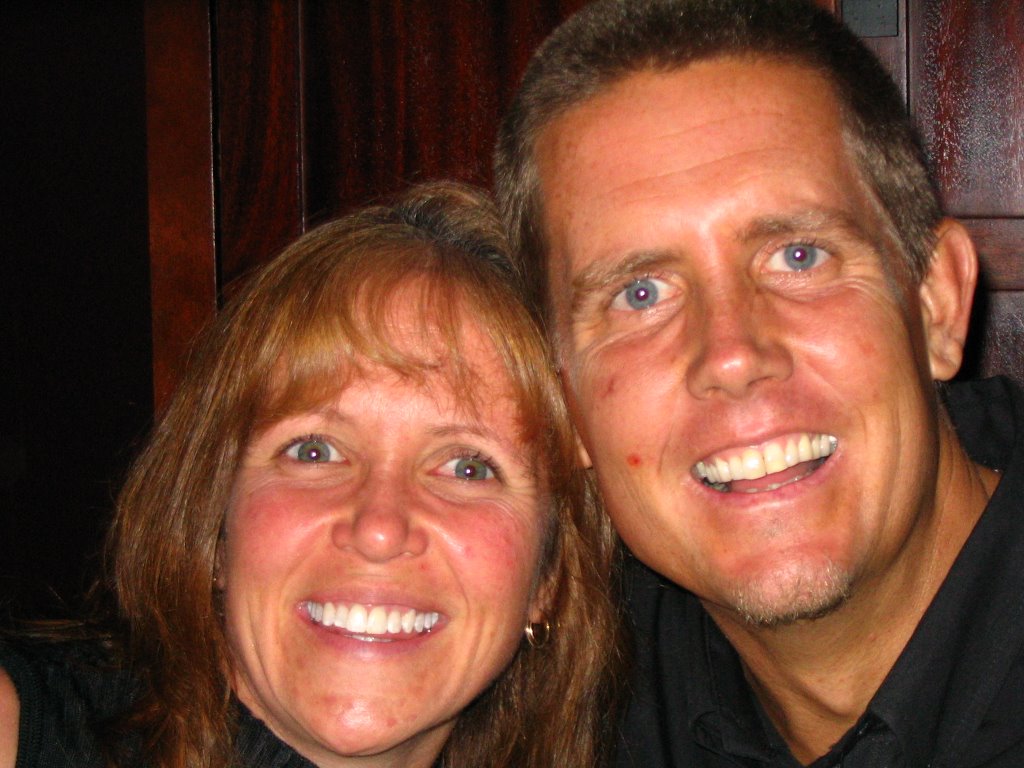
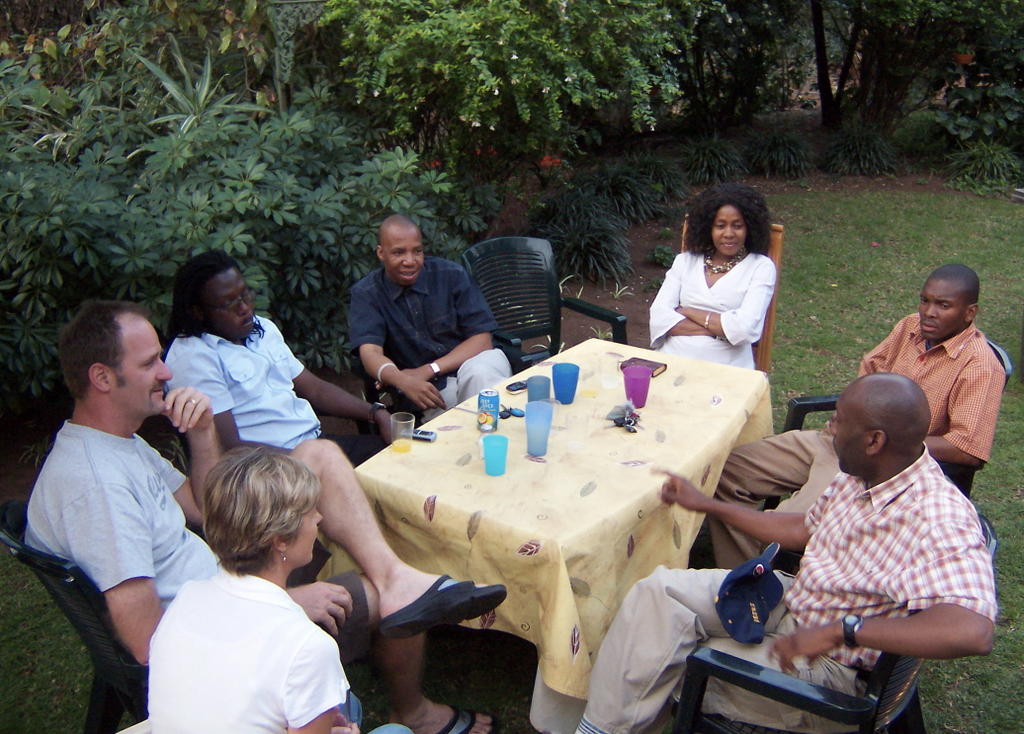
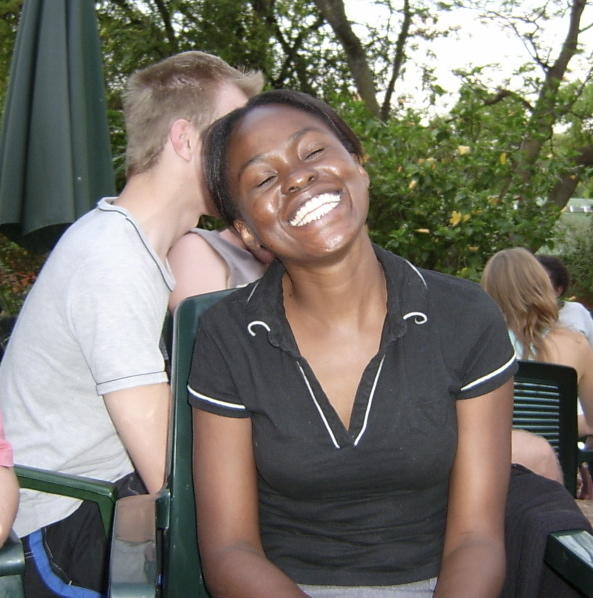
This past year Laurie and I and the couples pictured on this post--Sean and Deb Fraser, Bryan and Daleen Ward, and Arthur and Melissa Stewart--spent several months reading through John Gottman’s outstanding book, The Seven Principles for Making Marriage Work. It was a powerful experience for all of us. I recommend it highly if you’re ready to roll up your sleeves and work at making your marriage the kind of marriage you always dreamed it would be.

Last weekend, Laurie and I took a short flight up to Zambia to spend our 25th wedding anniversary at a place the local people call mosi-au-tunya, "the smoke that thunders." The English speaking world still calls it Victoria Falls, the name given to it by the explorer David Livingstone, and it truly is one of the Seven Wonders of the World. We expected it to be beautiful, and it was. But it is more than beautiful; it is awe-inspiring...almost scary. From miles away in any direction you can see the smoke (mist) rising up above the African bush and hear the daunting thunder. And then, when you approach the falls from the ridge that juts out directly in front of the river, you literally step out of a blazing African sun into a torrential rainfall that makes you want to reach out and grab something to steady yourself. The smoke that thunders. I now know why Livingstone found it the most spectacular site he ever stumbled upon in Africa.

Wednesday, April 26, 2006

finding family

Just down the road from us is a locked-down K-12 boarding school, called Tutela. It’s not a boarding school for privileged kids who don’t fit into their parent’s lifestyles. It’s a school for kids whose parents aren’t fit to raise them. It’s a place of refuge for kids who have been neglected, abused, or abandoned. Tutela is a kind of home for hundreds of kids who have never really experienced anything that resembles a true home.

I’ve often described NieuCommunities as a place where we gather young leaders around us to show them how to create home—spiritual home—for those who can’t seem to find it in all the normal places. If we fail to do that, then we have failed to meet one of the primal needs of humanity. And so, as I travel from site to site, I look for signs…signs that our communities of faith and training have also become spiritual homes; places of refuge and hope; places to encounter God and to dream again. Last Sunday night I saw one of those signs.

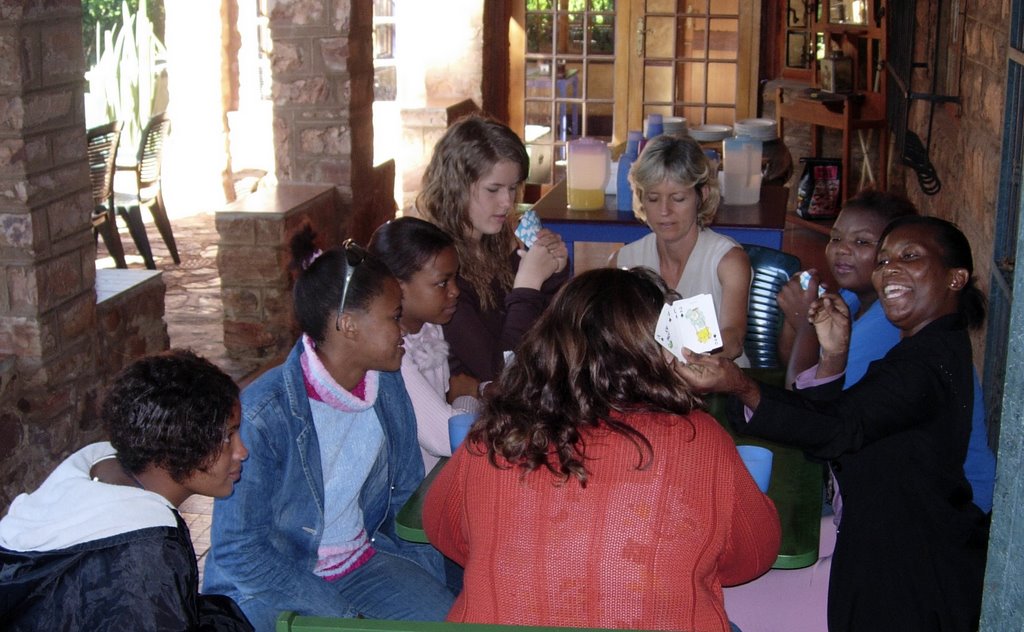
As she sometimes does, last Sunday afternoon Laurie drove over to Tutela to pick-up a van load of teenage girls and bring them to our weekly BBQ and time of spiritual reflection. To be honest, bringing these girls to our gathering is not as easy as it sounds. First, you have to become trusted enough by the administration of the school to take them off the secured campus. And second, most of these kids struggle to even know how to behave out in the “normal” world. Like a lot of young people I meet today—whether privileged or abandoned, black or white, American or South African—they have trouble experiencing the very thing they long for…home.But Laurie is awesome with these girls.

She is tender and nurturing. She walks them around the property and through our home to help them feel more comfortable in this new and strange environment. She brings them into the kitchen with her to help prepare the community dinner that they will join. She introduces them to all our staff and to all our guests, and she gently walks them through the evening’s experience.

As our weekly gathering was coming to a close, one of the girls voiced these words in an attempt to summarize what she was experiencing; “Everybody here feels like family.” It was a simple statement, but it was one of those signs of effectiveness I look for. In those few words Meloney both betrayed her heart’s deep desire and signaled that we had created what we had hoped for

May each of us, and all our communities of faith, become the kind of families in which people will experience a deep and satisfying sense of being at home and being at peace.

Tuesday, March 07, 2006

buying a bride

Once upon a time in America it was customary for young men seeking a bride to pay a dowry to her family. The idea was to give something back to the family for all they had invested in the woman they are about to give away. Somewhere along the way we discarded that tradition, which is too bad for a guy with two beautiful daughters!

Well, in South Africa, the dowry is called a “lobola,” and the tradition is still very much part of the fabric of the African culture, which creates a sometimes insurmountable obstacle for young men like my Congolese friend and teammate, Luc Kabongo, who has fallen in love with a wonderful South African woman named Petunia. This past Saturday I was part of a 6-person team (pictured at left) who traveled 250 kilometers south of Pretoria to meet Petunia’s family in a small mining township and negotiate a lobola on Luc’s behalf.

When we arrived at their small rural home, Luc was not allowed to enter the gate of the house. That’s part of the tradition. He and Petunia had to wait outside until the negotiations were completed. Our “team” was unique in at least 3 ways. First, we had 3 women on our team. These negotiations are traditionally done only by the men of the family, and women are not even allowed in the room. Second, we had 2 Americans on the team—myself and Arthur, another NieuCommunities
teammate. And third, being a refugee from the Congo and separated from his family, Luc’s team was comprised of his spiritual family, not his biological family. Several times I was referred to as the “papa” on the team, in a sense standing in the place of Luc’s father. Their team was comprised of 6 men, somehow all related to Petunia, and most hoping to get something out of this deal (pictured at right).

Now, I’ve been a part of lots of negotiations in my lifetime, but never anything like this. First of all, we were negotiating for a person. And second, we were negotiating in the currency of cows. Yes, cows! Our team’s hope was to “buy” Petunia for 5 cows. Now, nobody really expects to receive cows anymore. At one time in the culture the payment really was made in cows, but now it is made in Rand, the South Africa currency, with 1 cow equaling 1,000 Rand (about $165).

Anyway, back to the negotiations. When we entered the room, Petunia’s family asked us to state our intentions. We said that Luc had found a beautiful flower in Petunia, and that we had come to pick the flower, to pay them for the flower, and to bring the flower home to Luc. They welcomed us into their home, they thanked us for coming, and then promptly asked us for 20 cows! We were all a bit stunned, but quickly relieved when one of Petunia’s uncle’s corrected the mistake and adjusted the request to 12 cows. They explained that 2 cows were for Petunia’s “head,” and that those were not negotiable. I’m still not sure I fully understand what it means to buy her “head,” but the primary meaning has to do with purchasing the right to bury her with your family. If you don’t buy her head, then she would be buried with her birth family when she dies. After presenting their demand, they left the room so that we could discuss their request and respond.

When they returned, we assured them that 12 cows was certainly a very fair price for Petunia, and that she was surely worth much more than that. But we humbly told them that all we had was 6 cows, and that we would be willing to give them all we had. We told them that we just didn’t feel we could promise to give them more than we actually had. We were sincere, and honest, and they accepted the offer. We also agreed to give a gift to each member of the family who played a significant role in raising Petunia. They will then give us a list of the gifts they each would like to have, which typically are things likes dresses, or suits, or blankets.

After the lobola was negotiated, Luc was brought into the house and introduced to the family. That was the very first time he and her family actually met…only after the price was fixed and the transaction was agreed upon was he allowed into the house and introduced to the family.

Luc and the negotiating team will return to the village in November with the requested gifts and to get his bride. They will slaughter a sheep, there will be a feast, and the lobola payment will be made. In African eyes, that day, and that transaction signifies marriage, and Petunia will be given to Luc. One month later there will be a wedding ceremony back in Pretoria, and for Luc and Petunia, on that day, they will be married in both African eyes and in God’s eyes.

Sunday, December 25, 2005

from our hood to yours

Merry Christmas! Or as they say here, "Happy Christmas!"

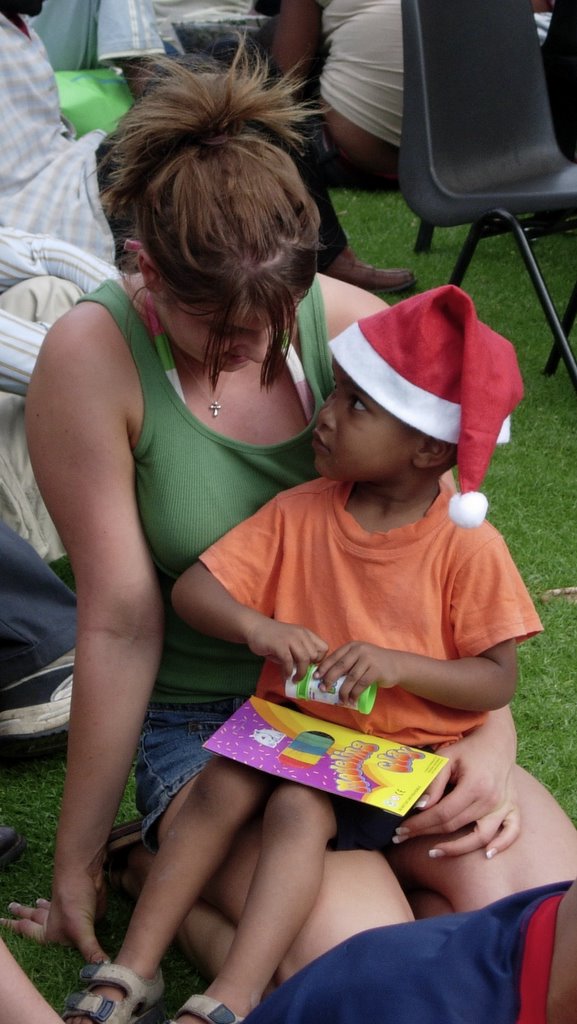
Christmas was different this year. We played Marco Polo in the pool under balmy African skies. We barbecued fish instead of cooking turkey. We spent it with our missions team instead of our extended family. And we went to Burgers Park (Pretoria's central park) to attend a Christmas program and to help serve food and pass out gifts to the poor and homeless. It wasn't your typical Christmas program or our typical Christmas experience.

The program was what you might call "low budget." The singing was somewhat strained as people from multiple cultures were trying to understand what was going on, let alone understanding the words of the songs. The dramas were simple, sometimes corny, and the acting was marginal. The food and gift distribution was somewhat chaotic, but at least everyone got a hot meal and every kid under 12 got 1 gift. But you know what? There was joy. And there was dancing.

Strained. Simple. Chaotic. It's certainly not what we're used to. But as I sat in the park among a few hundred poor and homeless people, I wondered if we were experiencing a Christmas more like the Christmas Joseph and Mary experienced than the kind of Christmas we ever could attending a well-choreographed performance held in a climate-controlled and omfortable sanctuary. I'm not sure anyone really knew how the day would unfold out there under the clouds and trees in the park. But in the end, everyone got a gift. And that's Christmas.

May Christ touch your heart this Christmas.

Saturday, December 10, 2005

this ain't kansas anymore

A few nights ago Jonathan—our 18-year old—needed to go downtown to catch an all night bus ride out to the coast to work at a youth camp for inner city kids. Jonathan hadn’t driven in the city center yet, and he wanted the practice. (Driving in South Africa is not like driving back home. You drive on the opposite side of the road, the driver sits on the right side of the car, and you have to learn to shift with your left hand instead of your right. All that takes a little getting used to, not to mention learning to drive in a dense urban environment).

Anyway, driving into the inner city of Pretoria at night also has its own unique challenges…the central one being to avoid getting car-jacked. As we were wandering around downtown trying to find the drop off spot, I found myself coaching Jonathan how to drive downtown at night. Just little things, like easing off the accelerator long before you come to a red light so that you never actually come to a stop; rolling through stop signs if you see guys standing anywhere near the intersection; and not getting too close to the car in front of you to avoid getting wedged between 2 cars.
As I got back into the car after Jonathan jumped on the bus, it struck me how interesting it was that our whole conversation about driving in the inner city at night was so nonchalant. It was just so natural, so matter-of-fact. Neither of us thought it was odd or even troubling to be talking about car-jacking and how to reduce the risk. I guess there are some things you just get used to in a place like this…things you adjust to and learn to live with.

But there are other things I don’t know if I will ever get used to…or even if I should get used to them. Last week I was reading an article in the local newspaper about the epidemic levels of rape and abuse in the city. In 1 downtown middle school, 52 girls reported to have been either sexually abused or raped at sometime in their lives. 52 girls in just 1 school! What is going on?! How do you explain that?

Well, there are sociological reasons that attempt to explain it. For example, it is commonly believed in many parts of Africa that having sex with a virgin will cure AIDS, and the younger the girl, the more likely that she will be a virgin. That’s one huge factor. Pervasive substance abuse is another major contributor to abuse.

But I suspect the deeper reason has something to do with the bankruptcy of people’s souls—something old time theologians would have called “depravity.” I find myself wondering if there is some correlation between being deprived and becoming depraved. I wonder if people actually forget what it means to be truly human—human in the sense in which God intended—if they have been treated as less than human for so long. I suspect that when people have been deprived of love for a long time, they actually forget how to love, and then they end up acting with unimaginable cruelty. Maybe that’s what depravity is really all about—forgetting how to love, and maybe that’s really not so odd. Maybe what’s really odd is when we expect people to act so well when they have been loved so poorly.

I’m not sure if there is anything we can do down here that would be more powerful, more transformational, than just loving people well. Loving them selflessly. When Jonathan spends 10 days hanging with inner city kids at camp, he is loving people well. When Laurie sits and talks with teenage girls at a local “place of safety,” a boarding school for kids who have been removed from their parents, she is showing them how to love. When Brittney goes out to a nearby township to spend time with some teenage girls there, something no other white girls that we know of would do, she is showing courageous love.

I’m really proud of my family. They are making their lives count down here in a place that is very different from anything we’ve ever experienced. I’m also proud of Melissa, our 20-year old who is back in San Diego in her 3rd year of college. She is a psychology student, and each week she volunteers at a local elementary school to counsel kids who have been removed from their classrooms because of emotional and behavioral problems. Melissa is also doing her part to change our world…one act of love at a time.

May we learn how to love—really love—and may it become contagious.

Wednesday, October 26, 2005

living right side up

Most of the people I know have a pretty well-honed sense of what it takes to fit in. If they’re younger, they know what it takes to be cool. If they’re a little older, they know what it takes to be considered successful. Within the social circles we traffic, we know how to be polite. If we go to church, we know what it takes to be proper.

So what is the right way to live in a country that was built on 350 years of black servitude? What’s the proper thing to do when you are living among white neighbors who grew up under a regime that both created and religiously enforced the systematic separation of blacks and whites under a body of laws collectively know as Apartheid? ("Apartheid" is an Afrikaans word meaning “separation,” which defined the legal and social relationship between blacks and whites from 1948-1990).

For us the right thing to do is to live right side up in an upside down world. The right thing to do is to do the very thing most people won’t do.

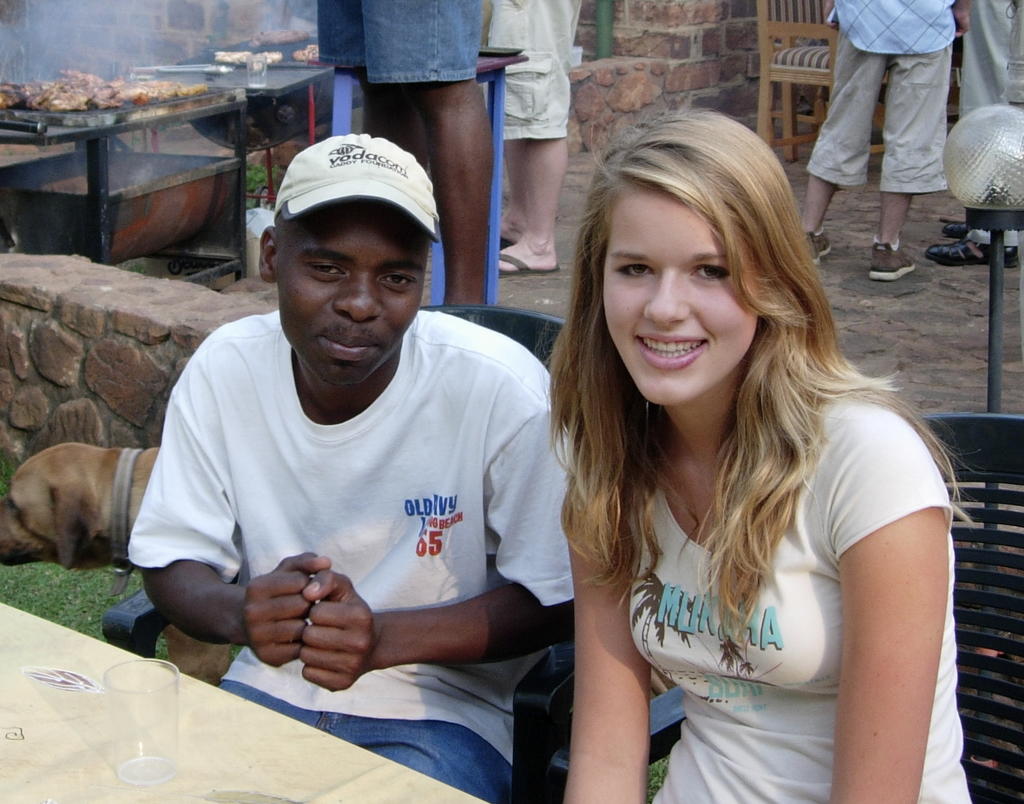
One of our favorite times of the week down here is Sunday afternoon. Each week we host a very culturally appropriate braai, (a South Africa BBQ), on our stoop and we invite all the folks we have befriended to join us. What makes it really fun though is that we draw a very culturally inappropriate crowd! There are poor blacks from the nearby township, upper middle class white students from the university, black children of domestic workers, white businessmen, Christian pastors and ancestor worshippers all sitting side-by-side.

Many of the people who come have never experienced an upside down gathering like this before, and you can bet our
neighbors haven’t ever seen a group like this gathered in their neighborhood! It’s just not the “right” thing to do.

But we just happen to think it gives our revolutionary God a great big smile. It gives us one too, so we’ll keep doing it. And in time we’ll see who else wants to live right side up in an upside down world.

Sunday, October 02, 2005

orienteering in the bush

Each year we take our missional community in South Africa out into the bush for an adventure in orienteering. We break them into teams, we give each team a compass and a set of coordinates to follow, and then we turn them loose to hunt for a series of markers and (hopefully) the spot where we will rendezvous for lunch. We haven't lost anybody yet out in the bush, but yeah, we definitely get lost! But that's part of the fun. And part of the learning.

The orienteering experience launches us into a 3-week learning focus we call LifeCompass. Building on the orienteering experience, we guide the community through an intensive self-discovery process in which we each create a new kind of map, a new kind of compass, and a destination worth giving our lives for.

The map is the story of our lives to this point. It's a personal timeline we each create in order to gain a better understanding of where we've come from and how God has been at work in us all along. It also reveals what may lie ahead. As we unpack our life journeys we gain a clearer sense of who we are, what we value, and what we have to offer. These learnings become our compass...a compass that keeps us on track and keeps us from drifting off in directions we were never meant to go. It keeps us focused on the destination we have been created to pursue.

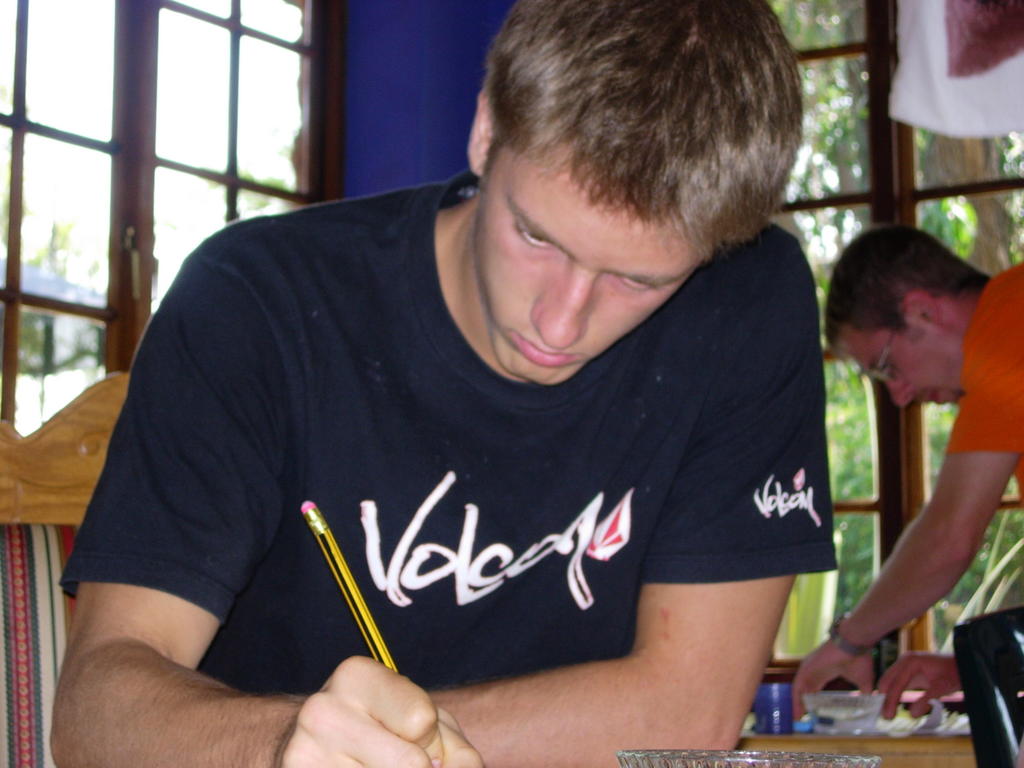
This past week we wrapped up our LifeCompass focus and we listened to each person in the community share their take-aways. It was an awesome and powerful experience. It was even more special this time around as Laurie, Brittney, and especially Jonathan (that's him in the photo) were able to join us throughout much of the process.

In another 6 weeks the participants who have joined us for this leg in their journey will be heading off in different directions. Some will be coming back to South Africa. One will be heading to Venezuela. Another to Dallas. A few will be traveling to Canada to explore a potential next step. But all will be leaving with a clearer sense of who they are and the destination they have been created for.

Saturday, September 10, 2005

into africa

It feels so good to be here! From the first day I began to architect NieuCommunities and help get it launched, I've wanted to live among the young leaders who are getting to experience what we designed. I've made lots and lots of trips to our sites over the past 4 years and I've had a taste of the adventure, but there's just no substitute for being here day in and day out.

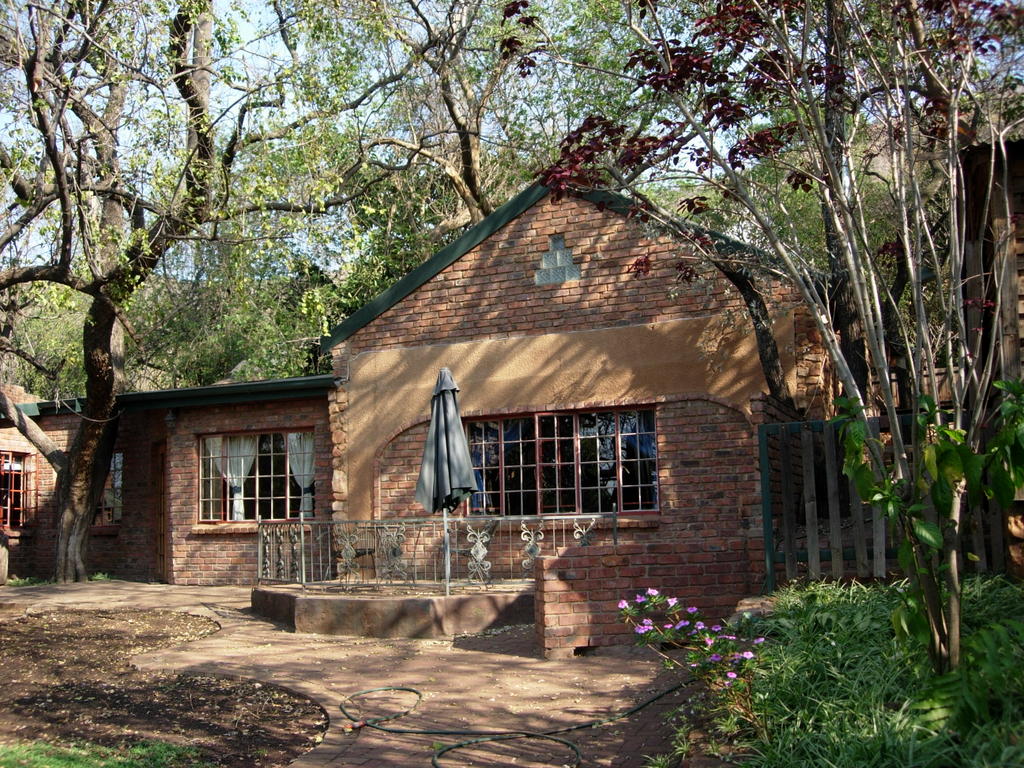
We've been having a blast settling into our little house on the Pangani property that also serves as the NieuCommunities Hub in South Africa. The team here had already done so much to fix up the house to have it ready for us...all we really needed to do was unpack our bags, move a few things around, and stock up the fridge and cupboards.

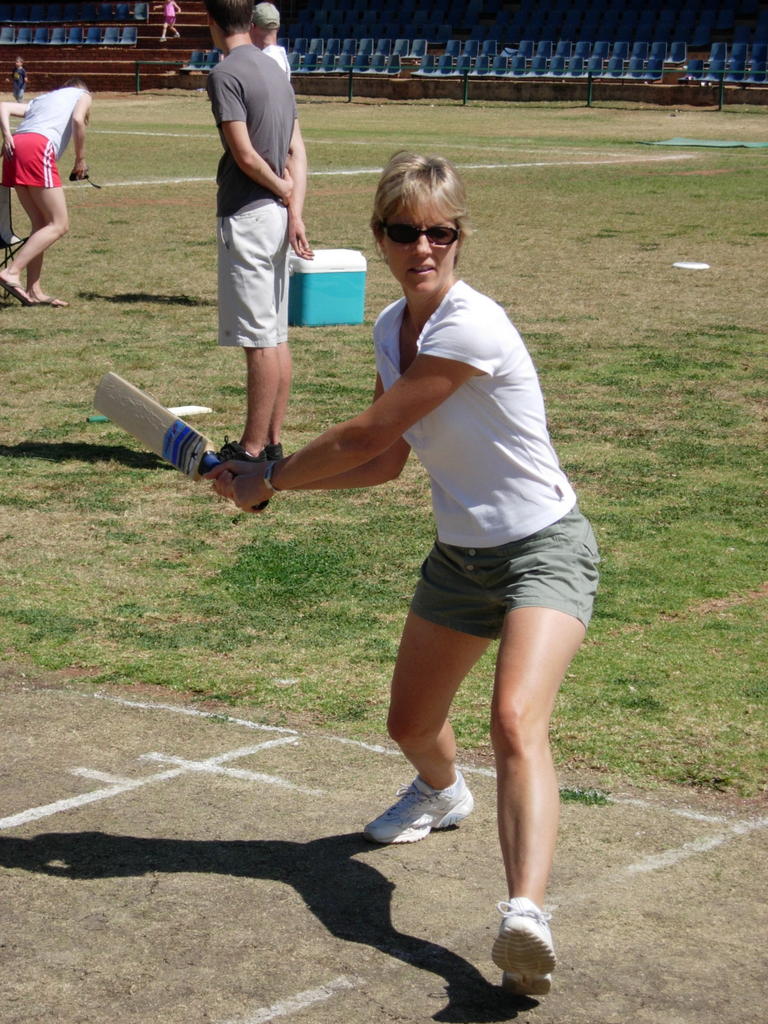
These first two weeks in Africa have been rich. First we were reunited with Jonathan who had already been here for over a month. I "guess" he was glad to see us...but he was sure having a lot of fun before we got here too and he was lovin' his independence! Then we were warmly welcomed by the whole community with a braai (South African BBQ) and a game of cricket...our first ever. (But take note of Laurie's natural swing).

We've been having a blast getting to know the whole NieuCommunities gang down here and having them all over for dinner at the clip of about one person every other night. We've loved hearing their stories and seeing what God has been doing in their lives. In just these first 2 weeks we have...
- participated in several rich times of worship and prayer with the community
- facilitated several training workshops
- attended a volleyball tournament to support one of our participants and the team he is playing with
- attended a very lively 3-hour church service in the black township of Soshanguve
- helped host a braai for our neighbors and another braai for a church group from the township of Soweto
- coached several staff and participants as they work on developing their "Life Compasses"
- planted grass in front of our house
- figured out where all the stores are
- eaten lots of good food
- enjoyed the company of an awesome group of young leaders!

I will use this blog page to capture our experiences this year and keep you up to date. So come back weekly and watch how the journey unfolds.

Email us and let us know how you are doing too. You can use the email function right from this web site. Just click on the little envelope icon at then end of this, or any article, and it'll take you right to an email screen. Looking forward to hearing from you!